Organic textiles · Sourcing guide
How to Evaluate Organic Sheet Makers: A Sourcing Checklist for Buyers
A certification logo can begin an inquiry, but it cannot finish one. To understand what makes a sheet genuinely organic, follow the material from field to finished fabric—and ask who can document each step along the way.
Shopping for organic sheets can feel like entering a room in which everyone is speaking the same language and using different definitions. One maker emphasizes the farm. Another points to a finished-fabric certificate. A third displays a tidy leaf symbol beside the word “natural,” which may describe a mood as much as a production method. For the buyer trying to make a careful decision, the problem is not a shortage of reassuring claims. It is knowing which claims answer which questions.
The useful question is not simply, “Are these sheets organic?” It is: Which fibers are certified? Which facilities handled them? Does the certification cover the particular product and the steps used to make it? And can the supplier show current documents that connect the answers? A sound sourcing inquiry follows the material through its transformations, from cultivated fiber to yarn, fabric, dyeing, finishing, cutting, and sewing.
This is not a demand that every maker deliver a documentary archive at first contact. It is a practical method for distinguishing specific, verifiable information from general assurances. Whether you are a consumer comparing sheet sets, a designer sourcing for a project, or a buyer assessing textile suppliers, a short, well-framed checklist can make the conversation considerably clearer.
Start with the product, not the slogan
“Organic bedding” is a broad phrase. It might refer to a product made entirely from certified organic cotton, a linen fabric made from certified organic flax, or a blend in which only one component is organic. It may describe the fiber but not the dyes, sewing thread, elastic, labels, or other trims. Before comparing makers, identify the object under consideration: a flat sheet, fitted sheet, pillowcase, or complete set, in a particular fiber, color, and size.
Then ask the supplier to define its claim in relation to that exact product. Is the sheet made from 100 percent organic fiber, or does it contain a blend? Is the claim about the agricultural origin of the fiber, the processing of the textile, or both? Does the certification apply to every color and product variation, or only to specified items? These distinctions do not automatically make one product better than another. They tell you what the claim actually means.
Keep a simple record of product name, fiber composition, color or dye variation, country of origin, and the supplier’s description of the certification. A claim attached to one sheet set cannot safely be assumed to cover every item sold by the same brand. A supplier may work with several mills, and product lines can change over time. Specificity, in this context, is not pedantry; it is how a buyer avoids confusing a company-wide aspiration with a documented product attribute.
Follow the chain, stage by stage
A sheet does not emerge from a field in its finished form. Fibers are prepared and spun into yarn; yarn is woven or knitted into fabric; fabric may then be dyed, printed, washed, softened, or otherwise finished. It is cut and sewn, inspected, packed, and moved through a series of businesses. Different facilities may handle different stages, and the brand on the finished package may not own any of them.
Ask the maker to map the relevant chain for the product you are evaluating. At minimum, seek the names or locations of the facilities responsible for spinning, weaving, dyeing or other wet processing, and sewing. Where a supplier cannot disclose a facility’s identity for a legitimate commercial reason, it should still be able to explain the facility’s role and how its certification or other documentation is verified. A map need not be elaborate. It should make the sequence legible.
Fiber origin deserves its own question. For linen, ask where the flax was grown; for cotton, ask where the cotton was cultivated. Then distinguish that agricultural origin from the locations where the fiber was spun, woven, finished, and assembled. “European linen,” for example, may refer to the source of the flax, while weaving and sewing take place elsewhere. Each fact can be meaningful, but none should be allowed to stand in for the others.
- Where was the fiber cultivated, and what documentation supports that origin?
- Which facilities spun the fiber and wove or knitted the fabric?
- Where did dyeing, washing, printing, or other wet processing occur?
- Which facility cut and sewed the finished sheets?
- Which stages are covered by the supplier’s certification, and which are not?
These questions are especially valuable when a product description compresses a complicated chain into a single phrase such as “responsibly made.” The aim is not to treat geography as a moral scorecard. It is to understand the route the material took and whether the claims made about that route can be checked.
Read certifications as documents, not decorations
Certifications can make textile sourcing more transparent, but different standards address different things. A certification logo is a prompt to investigate, not a complete account of a product’s history. Ask which standard is being used, who issued or verified the certification, what organization or facility it applies to, and whether it is current. If the maker supplies a certificate, check that the company name, scope, dates, and relevant processing activities are consistent with the claim being made.
The Global Organic Textile Standard, commonly known as GOTS, is a textile-processing standard for products made with certified organic fibers. Its requirements address more than the agricultural origin of a fiber, including aspects of processing and supply-chain oversight within the standard’s scope. The exact status of a product should still be verified: a business having some certified operations does not, by itself, establish that every product it sells is certified. Ask for documentation that relates to the product and the stages in question, and confirm that the supplier’s language matches the certification’s permitted claims.
Other labels answer different questions. OEKO-TEX standards, for instance, are associated with testing textiles or materials against specified criteria; an OEKO-TEX label should not be treated as proof that a fiber was grown organically. Recycled-content standards address recycled inputs, while organic-fiber standards address agricultural origin and, depending on the scheme, further processing requirements. Several labels can appear on one product, but they are not interchangeable. A useful buyer learns what each one covers before using it to compare suppliers.
Ask whether the supplier can provide a current scope certificate, product-specific certification information, or other relevant records. Depending on the scheme and the chain of custody, transaction documents may also help establish the movement of certified material between businesses. The appropriate paperwork varies; the important point is to understand what each document demonstrates and what it does not. A certificate showing that a facility is approved for a certain scope does not necessarily prove that a particular batch of fabric passed through it.
When in doubt, ask the certification body or standard owner how to verify a certificate, rather than relying only on a screenshot or a logo reproduced in a catalogue. A supplier that takes its claims seriously should be able to describe its verification process. If it cannot share a document publicly, it may be able to provide identifying details or explain how an authorized buyer can confirm its status.
Ask what “traceable” means in practice
Traceability is another word that can expand or contract depending on who uses it. For one maker, it may mean knowing the country where cotton was grown. For another, it may mean being able to identify the farm, spinner, mill, dyehouse, sewing facility, and movement of material between them. The difference matters. A supplier need not be able to disclose every commercial detail to give a useful answer, but it should define the level of traceability it can support.
Try asking, “Could you show me how you would trace this particular sheet set from the fiber source to the finished product?” The wording moves the conversation away from abstract commitments and toward an example. Ask what records connect one stage to another: invoices, production records, certificates, shipment documentation, or internal tracking systems. You are not expected to audit a supplier’s books. You are looking for a coherent account, supported by appropriate evidence, rather than a chain of unconnected claims.
It also helps to ask what happens when a supplier changes mills, farms, or factories. Are certificates checked again? Are customers notified when the source or production route changes? Is there a documented process for preventing certified and non-certified material from being confused? These are ordinary supply-chain questions, and ordinary is a virtue here. Credible systems tend to be explainable without theatrical language.
Look beyond fiber origin to processing
Organic cultivation is central to an organic-fiber claim, but it is not the whole manufacturing story. Textile processing uses water, energy, dyes, auxiliaries, and finishing agents. The relevant standard may restrict or manage certain inputs and processes, but buyers should avoid assuming that “organic” means every stage has zero environmental impact or that the fabric contains no chemical substances whatsoever. All textiles are made through processes; responsible claims explain how those processes are managed.
Ask what finishing treatments the fabric receives. Is it garment-washed, stone-washed, softened, printed, or treated to resist wrinkles or stains? Are these descriptions supported by product documentation? If a maker uses terms such as “chemical-free,” request clarification: the phrase is too sweeping to be a useful technical description. More precise answers identify the treatment, the standard or test that applies, and the limits of the claim.
Color can add another layer. A natural or undyed shade may avoid certain dye processes, but its description should not be mistaken for proof of organic origin. Conversely, a colored textile can still be made from certified organic fiber and processed under a relevant standard. Ask whether a certificate or testing claim applies to the specific colorway you are considering. This is particularly important when one catalogue presents a single certification statement alongside many shades and finishes.
Separate organic content from product quality
Certification tells a buyer something about sourcing and processing; it does not predict whether a fitted sheet will stay on a mattress, whether the seams will hold, or whether the fabric suits a particular sleeper. Those are separate questions, and they deserve equal attention. Examine fiber type, fabric weight, weave, construction, dimensions, elastic, seams, shrinkage guidance, and care instructions. In linen, thread count is generally less useful as a stand-alone quality measure than it is in discussions of cotton. Fiber quality, yarn, weave, fabric weight, and finishing all contribute to the finished hand and performance.
For fitted sheets, check pocket depth against the mattress and any topper, and look for a clear description of elastic construction. For sheet sets, confirm what is included in each size; pillowcase counts can vary. For any fabric, ask whether measurements refer to the product before or after washing and whether the maker provides expected shrinkage guidance. A product can be responsibly sourced and still be a poor practical fit for a particular bed.
Care instructions are not a footnote. They affect how a sheet performs over time and help establish whether its everyday upkeep suits the buyer. A maker that explains washing temperature, drying method, and recommended detergents is giving useful information about the fabric, not merely issuing household rules. Clear instructions also help reduce avoidable damage, which matters when a textile is intended for repeated use over many years.
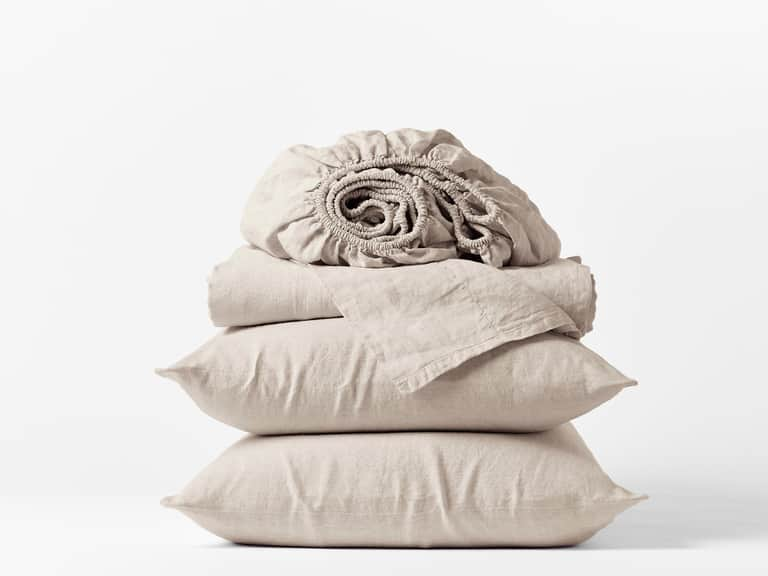
As an example of the kind of product-specific information worth looking for, the Organic Relaxed Linen Sheet Set is described as using organic flax grown in France and linen woven in Portugal, with GOTS certification and a 15-inch deep-pocket fitted sheet. Those details are a starting point for a buyer’s own verification: the origin statements, certification scope, and construction specifications should be considered separately, and checked against current documentation when they matter to a purchasing decision.
Use a consistent supplier questionnaire
When comparing more than one maker, ask each the same core questions. A standardized inquiry reduces the temptation to reward the most polished answer and makes it easier to see where one supplier is more specific than another. The following checklist can be adapted for a household purchase, a design brief, or a larger sourcing review.
- Material: What is the exact fiber composition of this product? Is any component blended or non-organic?
- Origin: Where was the fiber grown, and what evidence supports that origin?
- Production route: Where did spinning, weaving, dyeing or finishing, cutting, and sewing take place?
- Certification: Which standard applies, who certifies the relevant operation, and what is the current status?
- Product scope: Does the documentation cover this product, its colorway, and the relevant processing stages?
- Chain of custody: What records connect certified material at one stage to the next?
- Processing: What dyes, washes, softeners, or other finishes are used, and how are related claims substantiated?
- Construction: What are the fabric weight, dimensions, seam details, elastic design, and fitted-sheet pocket depth?
- Care and durability: What washing and drying instructions apply, and what should a buyer expect with repeated laundering?
- Change management: How does the maker review or communicate changes to suppliers, facilities, or certification status?
For a first conversation, it may be enough to ask for a product specification, a simple production map, and the certification details. If the purchase is high-stakes or involves a large volume, a more formal review may be appropriate. The level of scrutiny should fit the scale of the decision. The underlying habit—asking comparable questions and keeping the answers together—works at any scale.
Recognize useful answers, and warning signs
A good answer is not necessarily the most glamorous one. It tends to be concrete, bounded, and consistent. The supplier names the fiber, describes the relevant facilities, identifies the applicable standard, and explains which part of the process the document covers. If it does not know an answer immediately, it says so and identifies how it will find out. Such restraint is often more informative than a paragraph of environmental adjectives.
Be cautious when an organization makes broad claims but cannot explain the terms behind them; offers a logo without naming the standard; presents a certificate that does not appear to cover the product or activity in question; or describes an entire supply chain as local, organic, or traceable without identifying what those words refer to. These are reasons to seek clarification, not automatic proof of bad faith. Sometimes the issue is simply imprecise communication. The response to a reasonable follow-up question will tell you more.
Another warning sign is treating one virtue as a substitute for another. Organic fiber does not by itself establish fair working conditions, low water use, durability, or carbon performance. A country-of-origin statement does not verify organic status. A chemical-safety test does not demonstrate organic agriculture. Each claim needs evidence suited to the claim. Careful buyers resist the tidy fiction that one label can settle every question about a product.
Make the decision with proportion
No single sourcing checklist can turn a distributed global supply chain into a transparent object. Records may be incomplete or confidential; standards evolve; farms, mills, and manufacturers change. The practical goal is not certainty at any price. It is to understand what is known, what is documented, and what remains unclear, then decide whether that level of evidence is sufficient for the purchase.
For an individual buyer, the decision may rest on verified fiber content, a relevant certification, clear product details, and a maker willing to answer questions. A professional buyer may need more: current certificates, transaction records, facility information, and a process for reviewing changes. In either case, compare claims like for like. Do not mistake the length of a sustainability page for the strength of a sourcing system.
Sheets are intimate objects, but their making is anything but simple. A useful supplier conversation brings the complexity into focus without turning it into a performance. Ask where the flax or cotton began, who transformed it, how the claim is verified, and what the finished fabric is made to do. The answers will not make every uncertainty disappear. They will make it possible to choose with a clearer sense of what, exactly, is being chosen.
At a glance: the organic sheet sourcing checklist
- Identify the exact product and its full fiber composition.
- Separate fiber-growing origin from spinning, weaving, finishing, and sewing locations.
- Request current certification details that correspond to the product and relevant facilities.
- Ask what each standard verifies; do not treat organic, recycled, and chemical-testing claims as interchangeable.
- Seek a clear account of chain of custody and the records that support it.
- Review fabric construction, fit, care, and durability independently of certification.
- Record what the supplier can document—and what remains unverified.